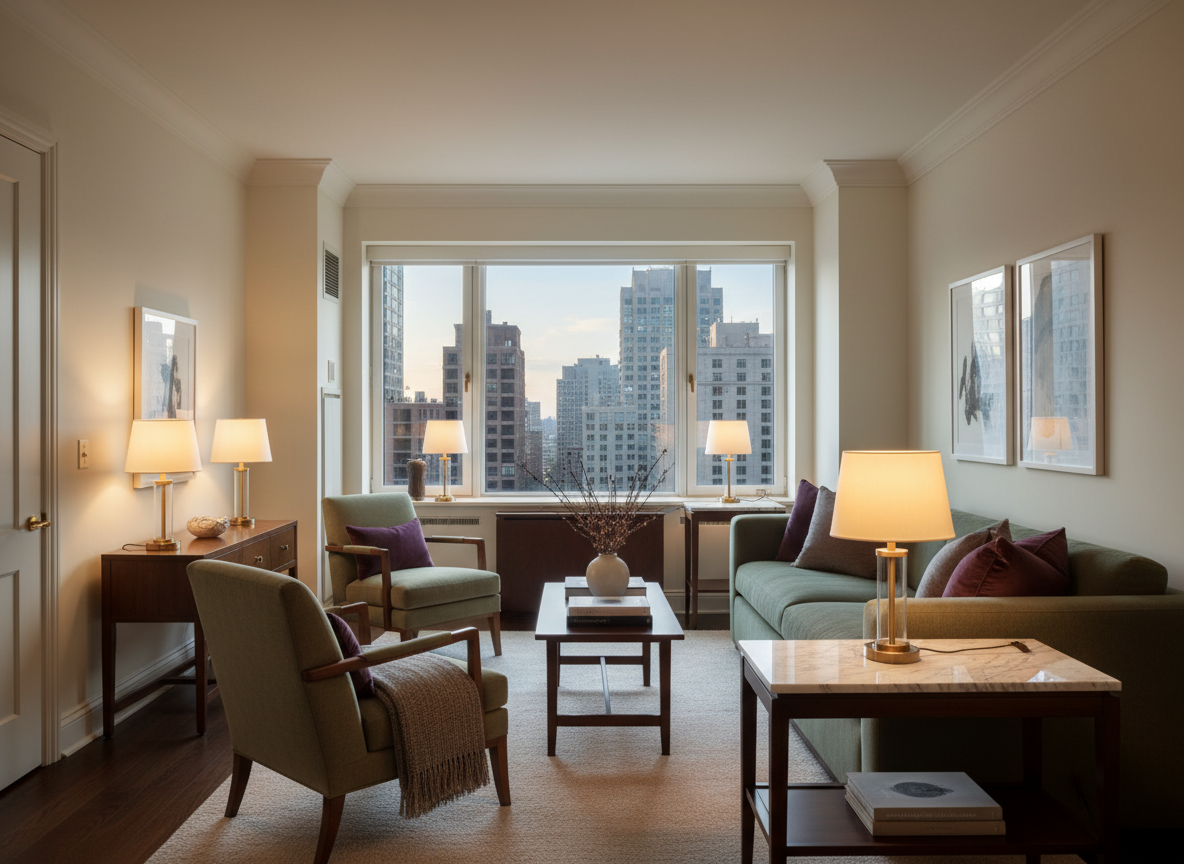
The tiny lamp trend is charming for exactly the reason it can go wrong: a small pool of light makes almost anything look more intimate. Put enough of those little pools around a room, though, and you can accidentally create a beautifully styled space where nobody can see what they are doing.
The useful version of the trend is not “replace every real light with a tiny lamp.” It is to use small lamps as the lowest, softest layer in a lighting plan that already handles the practical work.

Why little lamps are showing up everywhere
Design coverage throughout 2026 has emphasized warmer, more layered interiors and natural materials. House Beautiful recently highlighted “little lamps” as a way designers add intimacy and shape light through the day, while its September coverage of the year’s standout fixtures pointed to softer natural materials and character-rich rooms.
That makes sense after years of interiors dominated by bright recessed grids and large statement fixtures. A small lamp is less architectural. It feels collected, movable and personal.
A Peart Note
If a lamp is adorable but does not improve the room when it is switched on, treat it as decor. Do not count it toward the room’s actual lighting needs.
Start with three jobs, not three lamp sizes
A good lighting plan usually needs ambient light for general visibility, task light where work happens and accent light for atmosphere or emphasis. Our kitchen lighting guide explains the same principle in a more technical room.
Little lamps belong mostly in the accent layer. They can sometimes handle a small task, such as lighting a bedside book or a compact desk corner, but only if the shade, bulb and placement put enough light where you need it.
The best places for a small lamp
- Bookshelves: one lamp breaks up rows of books and creates depth after dark.
- Kitchen counters: useful for evening atmosphere after cooking, but never a replacement for task lighting.
- Entry consoles: especially good in apartments where the entry otherwise feels like a pass-through.
- Bedside ledges: a petite lamp can work when a full nightstand is impossible.
- Built-in desks: choose a lamp that actually throws light onto the work surface.
Cordless lamps solve placement, not brightness
Rechargeable lamps are useful on shelves, narrow consoles and other places without an outlet. The tradeoff is charging, battery life and often lower output. Before buying, check dimensions, stated brightness, charging method and whether replacement parts or bulbs are proprietary.
How many is too many?
In a small room, repetition becomes visual clutter quickly. Start with one or two strategic lamps and evaluate the room at night. If every surface gets its own tiny fixture, the effect can shift from layered to staged.
Vary height rather than buying a matching set. One low lamp on a shelf and a taller table lamp across the room usually feels more natural than three identical rechargeable lamps lined up at eye level.
The easiest formula for a small apartment
- Keep one reliable source of general light.
- Add task lighting where you read, cook, work or get ready.
- Add one little lamp in the darkest visual corner.
- Use warm, compatible light temperatures so the room does not look patchy.
- Stop when the room feels balanced rather than when every surface is filled.
For more small-space decisions, see small-space organization ideas and small reading nook ideas.